Global survey
FUNDING CUTS THREATEN PROGRESS ON BUSINESS AND HUMAN RIGHTS AT A CRTITICAL MOMENT
Organisations working on business and human rights report losing an average of 40% of their funding since 2024, according to a new sector-wide survey. This article highlights the survey’s key findings and examines what the funding crisis could mean for the future of corporate accountability.
A global survey conducted by Swedwatch, the European Coalition for Corporate Justice and the Business and Human Rights Centre reveals that respondent organisations working on business and human rights have lost an average of 40% of their funding since 2024, and one in eight say they will shut down if nothing changes.
The cuts come at a critical time, as corporate power and capture of democratic spaces grows, restrictions on civic space increase, and the climate crises worsens. Civil society participation and leadership in shaping the transition to green economies and supporting affected workers and communities is vital. The cuts risk jeopardising this essential work, setting back decades of hard-won progress in the field, and undermining the transformative potential of emerging mandatory human rights and environmental due diligence legislation. As resources for independent monitoring of corporate conduct and support for affected workers and communities decline, enforcement of mandatory due diligence requirements and other levers for accountability and prevention of harms will become increasingly reliant on corporate self-reporting. And as resources for advocacy decline, there is a risk that progress around legislation and stronger regulatory frameworks also backslides.
Defenders and civil society organisations will continue working to advance human rights, environmental protection, and social justice, even without financial resources. However, this work is made much more difficult by this significant cut in funding. As one example, decreased resources undermines the access of workers, communities, and other defenders to accountability processes.
The implications also reach across development priorities. Addressing the climate crisis and realising a just energy transition require urgent advocacy and legal efforts to ensure rights-respecting government responses and hold businesses accountable to emissions reduction standards. Progress on poverty and inequality is closely connected to decent work and living wages for workers in global value chains. Preventing deforestation and biodiversity loss requires effective risk-identification, oversight and accountability in high-impact sectors such as mining and agriculture. Protecting health requires addressing harmful pollution associated with mining, manufacturing and agriculture.
Cutting funding for organisations who contribute to these goals by documenting harms, supporting affected communities, advocating for stronger standards and holding companies and governments to account risks weakening progress across a much wider development agenda.
This article examines how funding cuts are affecting organisations working at the nexus of human rights, environment, and business and how the field is responding.
Findings summary: What 93 organisations across 40 countries report*
1️⃣Funding cuts are forcing organisations to scale back or close.
Organisations report an average budget cut of 40%, with 13% expecting to close if nothing changes. The impact is most severe in the Global South, where respondents reported an average cut of 49% and 17% of organisations anticipate shutting down if the funding situation does not improve. Two-thirds of all respondent organisations reported cutting programmatic activities, reducing travel, and/or reducing staff.
2️⃣Funding is becoming less flexible and more short-term.
Nearly half (48%) of all funding cuts affected flexible funding, while 73% of organisations report shorter average grant periods. Respondents shared that the most impacted strategies have been advocacy, capacity strengthening, and research and documentation.
3️⃣Organisations face widespread attacks.
Nearly two-thirds (63%) of organisations have experienced physical, legal, or narrative attacks. In the Global South, this rises to 72%.
4️⃣ The field needs resources to adapt to the funding crisis.
Organisations are increasingly looking to climate and environmental funders, but greater investment is needed to engage funders in other sectors and develop alternative funding models to ensure long-term sustainability for the field.
*See breakdown of respondents by country & organisation type in the side bar.
Funding cuts threaten to close organisations and reduce activities of those remaining
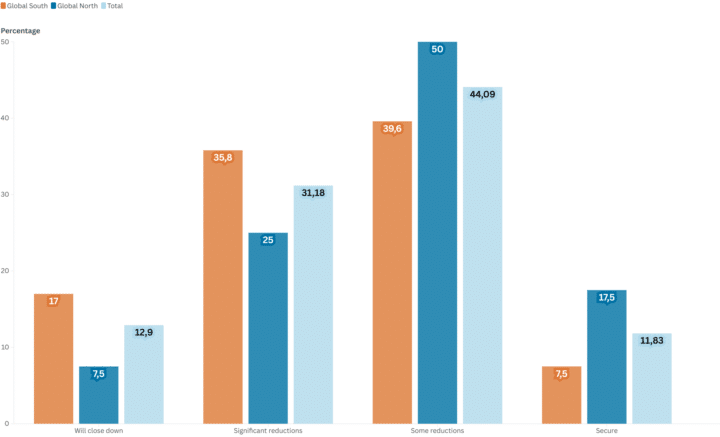
Between 2024 and 2026, respondent organisations lost an average of 40% of their budgets. Excluding the 11 organisations that reported no cuts, the average cut is 46%. The consequences are severe: 13% of organisations expect to close if funding is not restored, 31% anticipate significant reductions in staff and activities, and a further 44% expect more limited cuts.
The ripple effects of these funding cuts extend beyond respondents themselves. Forty-three percent say the cuts threaten their partners’ financial survival, 72% say they undermine partners’ long-term sustainability, and 31% report risks to their partners’ safety. Even before these funding cuts, workers and communities harmed by business activities faced a stark imbalance of power when seeking to hold companies accountable. The survey findings suggest these cuts will further weaken an already limited support network, as organisations close or scale back their work.
Staff losses will have lasting consequences for engagement with workers and communities. Among the 87 civil society organisations that responded to the survey, there was a reported loss of more than 450 full-time equivalent (FTE) positions, including positions lost since 2024 and expected cuts in 2027 onwards. Two thirds of all respondents and 71% of these 87 civil society respondent organisations reported reducing staff. Respondents also do not represent all organisations working at the nexus of human rights, the environment, and corporate accountability, meaning the true scale of loss is likely higher. Trust with workers and communities is often built through individual staff members, particularly in smaller organisations. Even if funding recovers quickly, rebuilding those relationships will take years.
The funding crisis is especially acute in the Global South. They face deeper funding cuts (an average of 49% reported funding cuts compared with 28% in the Global North) and a higher risk of closure, with 17% expecting to shut down (compared with 8% in the Global North). These organisations hold trusted relationships, local legitimacy and contextual knowledge.
Funding cuts were broadly consistent across business and human rights themes, with slightly larger reductions for organisations working on digital rights (50%), human rights defenders and civic freedoms (45%), and natural resource and land rights (43%). As respondents could select multiple thematic areas, these categories do not necessarily represent organisations’ primary or only focus.
By organisation type, “community-based organisations” experienced the largest average funding cuts (66%), followed by “networks or coalitions” (50%). Community-based organisations (which includes local trade unions), are often first points of contact for impacted workers and communities. Networks and coalitions play crucial roles linking the accountability ecosystem including through shared learning and strategy development. Large cuts to network organisations risk weakening support for and effectiveness of remaining organisations.
Respondents identified foundations (59%), INGOs (42%), and governments (31%) as the primary sources of the funding cuts they experienced.
Impact of funding cuts on organisations ⬇️
Cuts reach across the field, including already underfunded areas
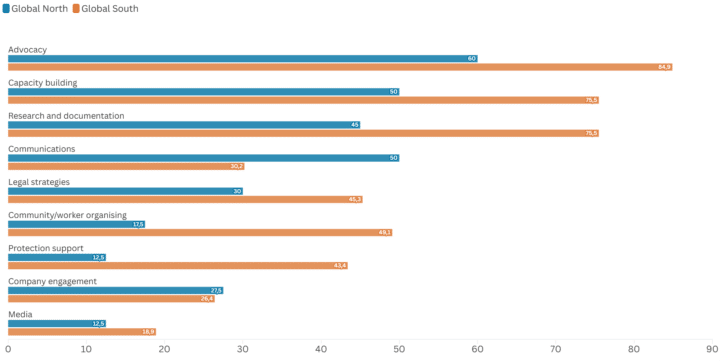
Respondents also identified which activities were affected by cuts. The figure below shows the share of respondents reporting impacts on each activity. Advocacy, capacity building and training, and research and documentation were the most frequently affected.
While no quantitative implications can be drawn from this data, when compared to Swedwatch’s previous estimates of the percentage of related human rights foundation funding that supported these strategies (based on HRFN’s 2020 analysis of foundation funding) a few concerns emerge.
Swedwatch estimates that less than 1%-6% of foundation funding in 2020 supported protection (0.1%), organising (2.1%), legal (1.3%), and research strategies (6.2%) by human rights organisations. While the survey did not reveal the quantity of funding cuts for these strategies, between 1 in 3 to 2 in 3 respondents reported funding cuts affecting protection (30%), organising (36%), and research and documentation (62%) strategies.
It is very concerning that already underfunded, critical strategies used in human rights work are now receiving less financial support. These are all foundational strategies for worker and community driven approaches to corporate due diligence, accountability, and strengthening both government and company policy and practice.
Moreover, while it is unsurprising that advocacy is the largest identified impacted activity, given that according to Swedwatch estimates it previously was the largest funded strategy (at 24.2% of related funding), it is nonetheless concerning in the context of growing corporate capture of democratic spaces and collaboration between business and governments to restrict civic spaces. The inequity of resources in democratic spaces is growing.
Type of work impacted ⬇️
As funding shrinks, the compliance industry grows
While most civil society and multilateral organisation respondents reported experiencing funding cuts, industry service providers, including social auditing firms and ESG service providers, continue to grow. One estimate projects that the social audit market size will rise from $19,4 billion in 2025 to $22,7 billion in 2026, making it 164 times larger than Swedwatch’s previous estimate of human rights foundation funding (2020) for civil society organisations’ work on research and documentation. Yet extensive civil society evidence shows that social audits often fail to capture severe human rights and environmental harms. The ESG ratings market also grew, from $11.7 billion to $12.7 billion in the same period. A 2025 OECD analysis of eight major ESG ratings products found that more than 80% of human rights metrics relied on companies’ self-disclosed data, effectively ceding oversight to the companies themselves.
As funding for workers, communities and the ecosystem of actors supporting them disappears, the question is what the billions of dollars for industry service providers will actually be buying. Without information from the communities, workers, and other defenders most affected by business risk and harm, companies and investors do not have vital data they need to conduct robust human rights and environmental due diligence. This can increase businesses’ legal, financial and reputational risks. These billions may pay for a veneer of compliance with mandatory due diligence laws, while the reality is another failed period of self-regulation and communities and workers experiencing harm.
Funding quality is declining, weakening accountability efforts
The length and flexibility of grants shape organisations’ ability to pursue effective accountability strategies. Beyond overall funding cuts, the survey points to a significant decline in funding quality.
Nearly half (48%) of all funding cuts since 2024 affected core or flexible funding, despite flexible funding already being scarce. According to the Human Rights Funders Network, flexible foundation funding for human rights hit an all-time high in 2021 at 32%. That high was reached during the height of the response to the pandemic, and in 2019 and 2020 the percentages were 26% and 27%. It is therefore concerning that such a high percentage of funding cuts captured in our survey are described as cuts to core or flexible funding, suggesting a disproportionate impact on these funds.
What is particularly concerning is the impact on organisations in the Global South. Global South based respondents reported that 56% of their funding cuts affected flexible funding (compared to respondents in the Global North at 37%). Given that these organisations, according to HRFN data (2021), previously received just 18% of total flexible foundation funding, the findings suggest this vital resource is disappearing fastest for global south organisations. Previous Swedwatch research shows that flexible funding is critical to effective accountability for business harms. It enables workers and communities to adapt to changing circumstances, respond quickly to attacks, take advantage of unforeseen strategic opportunities, and pursue the multi-pronged strategies often needed to achieve remedy.
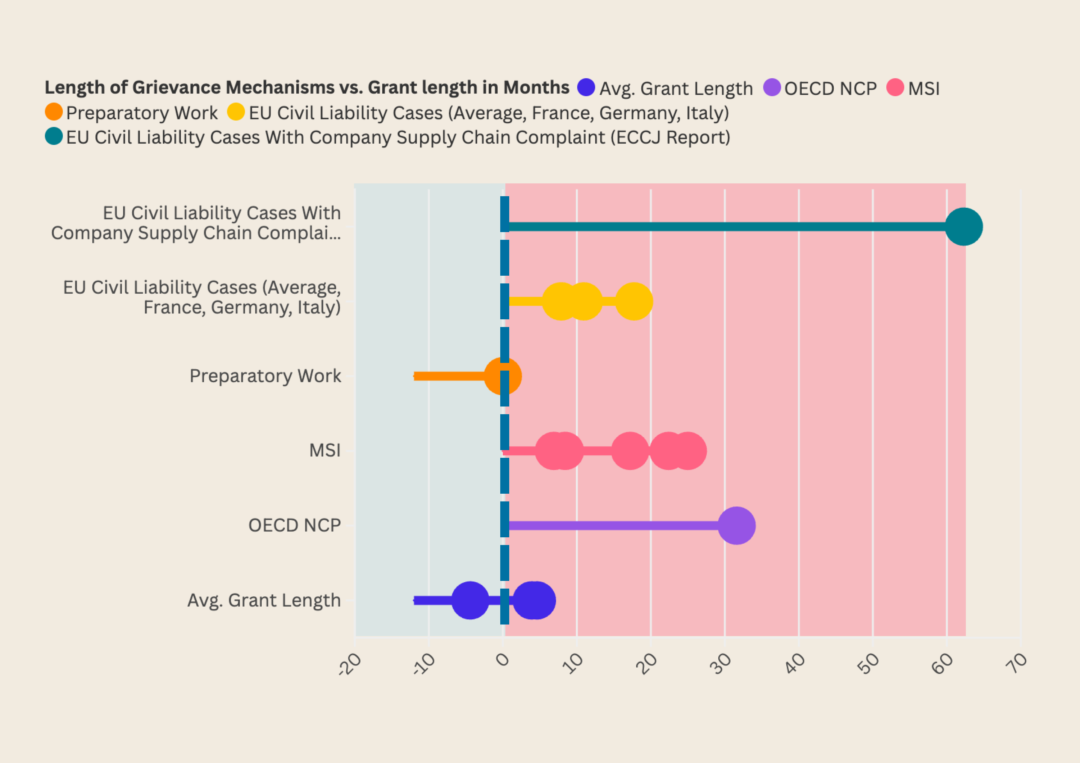
Grant periods are also getting shorter, with 72% of respondents reporting a reduction in average grant length. The trend is even more pronounced in the Global South, where 83% of organisations reported shorter grants (compared to 58% in the Global North). Even before these cuts, average grant lengths were often too short to support cases through judicial and non-judicial grievance mechanisms (as seen in the chart below). Without sustained funding to take cases from grievance to remedy, enforcement of mandatory due diligence legislation will remain sporadic at best.
What is particularly concerning is the impact on organisations in the Global South. They reported that 56% of their funding cuts affected flexible funding. Given that these organisations previously received just 22% of total flexible funding, the findings suggest this vital resource is disappearing fastest for those closest to workers and communities affected by business activities. Previous Swedwatch research shows that flexible funding is critical to effective accountability. It enables workers and communities to adapt to changing circumstances, respond to company tactics and attacks, and pursue the multi-pronged strategies often needed to achieve remedy.
Grant periods are also getting shorter, with 72% of respondents reporting a reduction in average grant length. The trend is even more pronounced in the Global South, where 83% of organisations reported shorter grants. Even before these cuts, average grant lengths were often too short to support cases through judicial and non-judicial grievance mechanisms, as also shown in the 2025 Swedwatch report Overdue Diligence (figure p 47). Without sustained funding to take cases from grievance to remedy, enforcement of mandatory due diligence legislation will remain sporadic at best.
Average grant length (pre survey) compared to length of accountability processes ⬇️
Funding cuts coincide with widespread attacks on organisations
At the same time organisations are facing deep funding cuts, they are also confronting widespread narrative, legal and physical attacks. Overall, 63% of organisations reported experiencing at least one form of attack. 1 in 3 organisations reported threats against team members, while 13% reported physical violence. 1 in 5 organisations had been accused of collaborating with foreign actors, another fifth had their work misrepresented in the public sphere, and 13% had experienced a Strategic Lawsuit Against Public Participation (SLAPP). Each of these attacks have serious effects on organisations. For example, just the fee faced by Greenpeace from the Energy Transfer SLAPP would account for 16% estimated total funding for business and human rights prior to these cuts, according to Swedwatch’s previous estimate.
Attacks are even more widespread in the Global South, where 72% of organisations reported experiencing at least one attack. This includes 45% that reported threats against team members and 21% that reported physical violence. Organisations in the Global South also reported a higher level of smear campaigns (21%) and digital attacks (26%) compared to Global North-based respondents (5% and 8%). Simultaneously Global South-based respondents reported facing deeper funding cuts and having fewer flexible resources to respond.
Experience of attacks ⬇️

On the field’s response
In the short term, organisations are responding to funding cuts by reducing programme activities (69%), travel (68%) and staff (67%). There are also some differences between respondents based in the Global South and Global North: organisations in the Global South are far more likely to cut programme activities (81% compared with 53% in the Global North), while those in the Global North are more likely to have drawn on financial reserves (45% compared with 26%).
To address the funding crisis, organisations are primarily targeting climate and environmental foundations, alongside the remaining human rights foundations. Additionally, one in five respondents indicated they are exploring earned income strategies and a smaller number referenced exploring local or community donations.
There were additional differences between Global North and Global South-based respondents. 34% of Global South-based organisations said they were prioritising corporate foundations, compared to 18% in the Global North. Moreover 40% of Global North-based organisations prioritised government donors while only 11% of Global South organisations did so. This could reflect the administrative and reporting requirements from government donors which make them inaccessible for many smaller organisations.
Priorities for fundraising moving forward ⬇️

When asked which fundraising strategies, in aftermath of these cuts, had been most successful, climate and environmental funders were the most common response, cited by 17 organisations. Human rights foundations and earned income were each identified by eight respondents. Forty-five respondents either reported no success in fundraising or did not answer the question.
The findings point to a broader need for support in diversifying funding sources and exploring alternative financing models. Both expanding engagement with other thematic funders, including public health, climate and education, and developing and implementing alternative funding models would benefit greatly from active financial and technical support from existing funders committed to advancing human rights, environmental protection, and corporate accountability.
Building more resilient funding models cannot be left to individual organisations alone. It requires field-level investment in developing new funding approaches, sharing learning, engaging donors and fostering collective strategies. It is also vital for remaining funders to increase flexible and multi-year funding to help organisations survive the current crisis.
Breakdown of respondents by country & organisation type
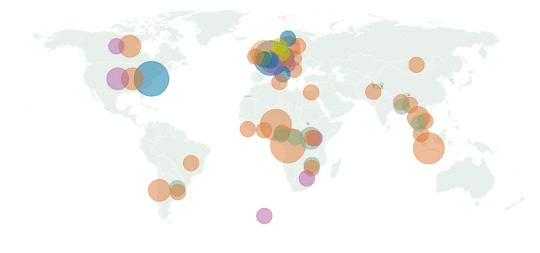
National non-governmental organisation : ● (46)
International non-governmental organisation: ● (16)
Network or coalition: ● (12)
Community based organisation: ● (11)
Government-affiliated institutions: ● (3)
Multilateral: ● (3)
Regional organisation: ● (2)
Without information from the communities, workers, and other defenders most affected by business risk and harm, companies and investors do not have vital data they need to conduct robust human rights and environmental due diligence.
Contacts

Swedwatch
Benjamin Claeson
Programme Officer, main coordinator of the survey
benjamin@swedwatch.org

Contact European Coalition for Corporate Justice
Alice Poiron
Communications Officer
alice.poiron@corporatejustice.org

Business and Human Rights Centre
Christen Dobson
Co-Head of the Civic Freedoms & Human Rights Defenders Programme