Analysis
The proposed EU Procurement Act: does it live up to expectations?
The European Commission’s proposal for an EU Public Procurement Act takes important steps forward on sustainability, but its impact on workers and communities will ultimately depend on the extent to which human rights due diligence is embedded in the final legislation. Without it, taxpayers’ money may still be fueling well-documented human rights violations in public sector supply chains, while weakening the competitive edge that responsible business conduct can give EU companies over their non-EU counterparts.
In short
WHAT AND WHY?
The EU is revising its public procurement rules at a time of growing geopolitical and economic uncertainty, seeking to strengthen European competitiveness and reduce dependence on a volatile transatlantic relationship. On 9 September 2026, the European Commission released its proposal for a new EU Public Procurement Act.
OPPORTUNITY +
Competitiveness and sustainability can reinforce each other. Ambitious HREDD requirements could improve conditions for workers and communities while rewarding EU-based suppliers already adapting to emerging due diligence rules.
SHORTCOMING −
The European Commission’s proposal is a welcome step forward, but after 15 years of UN calls to use public procurement to protect human rights, it still stops short of mandatory social conditionalities to strengthen corporate accountability.
WAY FORWARD →
Public procurers are ready to act. To unlock their potential, they need clear legal incentives, sufficient capacity and political backing to advance responsible business conduct.
Learn more in our analysis 👇🏼
Public procurement represents roughly 15% of the EU’s GDP, amounting to an estimated €2 trillion each year. This makes public procurement about far more than buying goods and services at the lowest possible price; it is also an instrument to advance strategic goals. The European Commission has clearly recognised this potential: amid geopolitical unrest and sleeping trade conflicts, it has presented the revision of the EU Public Procurement Directives as a landmark opportunity to bolster EU industry and restore its strategic autonomy. This explains the recurring debates concerning if and how public procurers can “buy European” goods and services – in other words, whether public procurement could and should be used to favour European industry and shield it from competition from China and the United States.
Public procurement as the talk of the town
The revision of the Public Procurement Directives can not be seen separately from Europe’s reckoning with the need to become more strategically, and thus economically independent in the face of Trump’s America-first economic policy. If U.S. Vice-President J.D. Vance’s speech at the Munich Security Conference in 2025 awakened anything among EU Member States, it was the realisation that Europe is increasingly on its own. Subsequent U.S. tariff threats and attempts to take over Greenland have brought public procurement into the centre of a potential trade war, raising questions over whether the EU should restrict American firms’ access to public tenders in the Single Market through the rarely used Anti-Coercion Instrument, dubbed the EU’s “trade bazooka”.
Against this backdrop, rebuilding industrial competitiveness has been presented as the go-to solution for restoring Europe’s sovereignty – if needed, through substantial regulatory overhauls. The release of the Public Procurement Act certainly ticks this box: it repeals three Public Procurement Directives and replaces them with a single Act, while amending a whopping 11 others.
At the same time, however, the Act is being introduced in a context where social and environmental legislation is being rolled back under the guise of “simplification”, as centre-right policymakers continue to argue that the EU Green Deal and forthcoming sustainability legislation undermine Europe’s industrial competitiveness. Yet evidence from the UN suggests that this is at best a false dilemma and, at worst, a convenient excuse for advancing neoliberal policy.
Due diligence as a strategic lever
In the case of public procurement, where taxpayers’ money is used to provide goods and services in the public interest, the long-held belief that there is a trade-off between respecting human rights and competitiveness is particularly misguided. As Swedwatch and the International Working Group on Ethical Public Procurement argued in their input to the European Commission, requiring bidders and suppliers to demonstrate robust human rights and environmental due diligence (HREDD) would in fact create the opposite effect. Not only would this incentivise companies seeking public contracts to strengthen their practices and build more resilient supply chains – reducing their exposure to supply chain disruptions, legal liabilities and reputational damage – it could also be a geopolitically smart move on the part of the EU.
As the Trump administration continues to seek exemptions for U.S. companies from obligations under the EU’s Corporate Sustainability Due Diligence Directive (CSDDD), and American businesses lobby aggressively against the legislation, the EU has a chance to turn around the narrative pushed by German Chancellor Friedrich Merz and other conservatives of the bloc as a “world champion in over-regulation”, into one that works in its advantage.
If many EU Member States are indeed concerned about market flooding by Chinese products or overreliance on American production, then surely embedding HREDD requirements in European public procurement – alongside an ambitious shift away from lowest-price criteria – would naturally favour EU-based companies already adapting to the rapidly changing regulatory landscape on responsible business conduct.
The human cost of cheap procurement
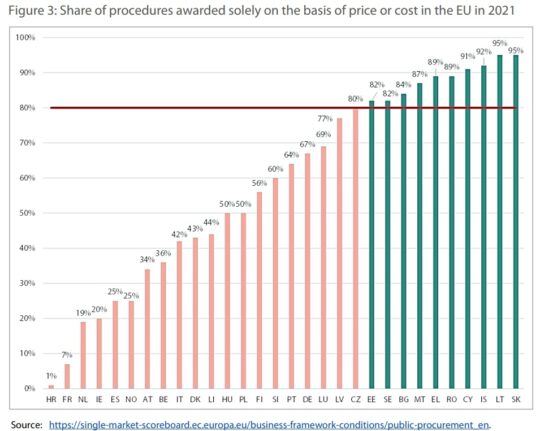
The principle should be simple: taxpayers’ money must not support companies that violate human rights. Yet public supply chains remain rife with labour abuses, environmental harm and other rights violations affecting surrounding communities. The current EU procurement framework continues to prioritise cost efficiency, often at the expense of broader policy goals such as climate action, human rights and labour protection. A 2023 European Court of Auditors report underscored this shortfall, finding that strategic procurement “has had a limited impact overall”, with most procedures still awarding contracts based solely on price. This also runs counter to the UN Guiding Principles on Business and Human Rights (UNGPs), which call on states to use public procurement as a lever for protecting human rights by embedding expectations for responsible corporate conduct in bidding and contracting.
Swedwatch has repeatedly seen the consequences of these persisting policy gaps. Our latest study, Public Money, Private Harm, based on a multi-year investigation with AwazCDS-Pakistan, examined labour conditions at factories in Faisalabad and Karachi producing healthcare textiles, such as hospital bed linen, for Swedish regional authorities. Workers interviewed by Swedwatch reported poverty wages, unsafe and discriminatory conditions, excessive working hours, harassment and union suppression, while audits and grievance mechanisms often fail to identify risks or address harms that have already occurred. Together with our previous research on poultry production in Thailand and surgical instruments in Pakistan, these findings show that EU Member States continue to indirectly source from factories where serious labour rights violations occur.
It would be too easy to blame public contracting authorities for this predicament. Our experience repeatedly indicates that procurers are making real efforts to purchase responsibly. At local, regional and national level, public procurers across EU Member States are experimenting with due diligence as a contract performance condition and imposing stricter product- or sector-specific requirements. Procurers do not lack the goodwill, but the legal incentives to opt for someone else than the lowest bidder.
The proposed Public Procurement Act
On Wednesday, 9 September, the European Commission released its long-awaited proposal for an EU Public Procurement Act – a landmark initiative described as a sweeping overhaul of the EU’s public procurement rules.
The European Commission’s proposal contains several promising changes which may help address the above concerns. For starters, it suggests moving from lowest price as the predominant award criterion and paves the way for public buyers to give greater weight to qualitative criteria, including social and environmental considerations. This is essential, as an assessment of European public procurement from 2023 found that the use of the lowest price remains widespread across EU Member States (see Figure below), while “the use of quality criteria, including social, environmental and innovation considerations alongside price or cost as award criteria is still very limited”.
The proposal also recognises workers’ conditions in global supply chains, responsible sourcing and supply chain transparency as relevant to public contracts; mentions human rights protection across supply chains as a social objective public buyers may pursue; and refers to “sustainability due diligence” as an example of an environmental contract performance condition.
While these are all welcome improvements, the current text lacks the teeth to prevent irresponsible suppliers from winning public contracts at the expense of more responsible competitors – for three reasons.
First, the Commission fails to introduce mandatory social conditionalities to promote fair working conditions and accountability throughout supply chains. Similarly, it stops short of explicitly recommending HREDD as a preferred award criterion or contract performance condition, despite the fact that such requirements would help ensure that public sector suppliers identify, prevent, mitigate and remediate adverse human rights and environmental impacts across their supply chains.
Second, it repeals Article 31 of the CSDDD, which confirmed that compliance with due diligence obligations could be considered an environmental or social award criterion or contract performance condition in public procurement. Moreover, the Act does not replace this provision with a corresponding obligation for public procurers to require and monitor compliance with – and thus help ensure the meaningful implementation of – the CSDDD.
Third, the way in which the Commission’s proposes a shift away from lowest-price procurement offers no guarantee that more contracts will be awarded based on social and environmental performance. Procurers would be required to assign only 30% of the weighting to quality criteria, with quality criteria encompassing a broad range of considerations beyond social and environmental performance, ranging from innovation to European preference. This could relegate fair working conditions in public supply chains to one consideration among many – or leaving them out altogether – rather than making them a mandatory condition for driving ethical purchasing decisions. A “comply or explain” mechanism would also allow procurers to still rely on lowest price where they can justify how quality will otherwise be ensured.
No one’s against more transparency
If there is one thing parties across the political spectrum often agree on, it is that taxpayers’ money should be spent transparently. While the Commission appears to recognise this principle, substantial gaps remain.
For contracting authorities to make ethical and informed purchasing decisions, they need consistent access to information on working conditions at production sites, impacts on affected communities and suppliers’ due diligence processes. Yet the proposal does not guarantee such access, despite establishing national and European Union-level Public Procurement Data Spaces. The idea of data spaces could be a promising feature, but they could be of particular value if they: (a) collect and host ESG-relevant supplier data from both primary sources, including NGOs, trade unions and worker- and community-based organisations in supplier countries, and secondary sources, such as media reports on corporate controversies; and (b) provide a channel for these organisations to report adverse impacts linked to actual or potential suppliers to public authorities.
Legal certainty and guidance
Both procurers and companies appreciate legal certainty and implementation guidance. On legal certainty, the Commission provides a clearer legal basis for procurement criteria to cover not only the characteristics of the final product or service, but also the conditions under which it is produced and delivered, including the “working conditions of the workers involved in any of those stages of the life-cycle and responsible sourcing and supply chain transparency”. This is intended to resolve long-standing uncertainty around the so-called “link to the subject matter”: the principle that procurement requirements must relate directly to what is being purchased, rather than to the company’s general policies or practices. The proposal therefore continues to prohibit procurers from imposing requirements concerning “general corporate policy”.
Yet this leaves an important question unanswered: can a company’s human rights policy, environmental policy or supplier code of conduct be considered sufficiently linked to a specific contract, given that such policies may shape the production and working conditions relevant to that contract, but also apply more broadly across the company’s operations and supply chains? While this ambiguity has certainly not prevented the Swedish regions from asking suppliers to provide due diligence policies for years, less confident contracting authorities may be deterred from doing these same for fear of legal challenges.
Lastly, while the Commission aims to accompany the legislation with practical implementation tools, EU-level guidance and model contract clauses on due diligence are notably absent. The experience of the Swedish Regions demonstrates the value of applying contract clauses proportionate to the risks associated with a contract and the maturity of a supplier’s due diligence system. It would be a missed opportunity if the EU did not draw on this experience.
A chance to make public spending work for workers, communities… and Europe
Without mandatory social conditions and firm due diligence requirements in public procurement, workers producing goods and delivering services for the public sector, as well as communities affected by suppliers’ activities, may continue to face severe human rights violations. The Commission’s proposal should therefore be seen as a step towards a more progressive procurement framework, but it nonetheless lacks the ambition needed to fundamentally advance responsible business conduct.
Unlike protectionist preferences, which may deliver short-term gains, putting responsible business conduct at the heart of the legislation would align Europe’s public spending with its values and international commitments while strengthening its long-term economic resilience and strategic autonomy. As the proposal moves through the legislative process, the European Parliament and EU Member States have an opportunity to make that choice.
See also IWGEPP’s joint statement around the Public Procurement Act.