New report
THE HIDDEN COSTS OF TIN MINING
Tin is essential for technologies driving the green transition, but its extraction comes at a heavy cost. A new report reveals how tin mining in Indonesia’s Bangka Belitung Islands, which supply around one-fifth of the world’s tin, is destroying ecosystems, trapping communities in a cycle of dependence on mining. The findings raise questions about how global companies sourcing tin address human rights and environmental risks in their supply chains.
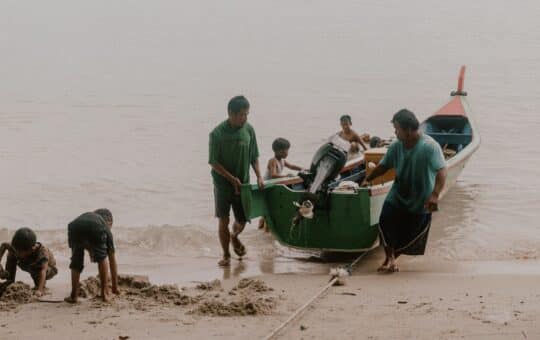
For generations, fishing and farming have sustained communities on the Bangka Belitung Islands, located off the southeastern coast of Sumatra. Today, the foundations of this way of life are being eroded.
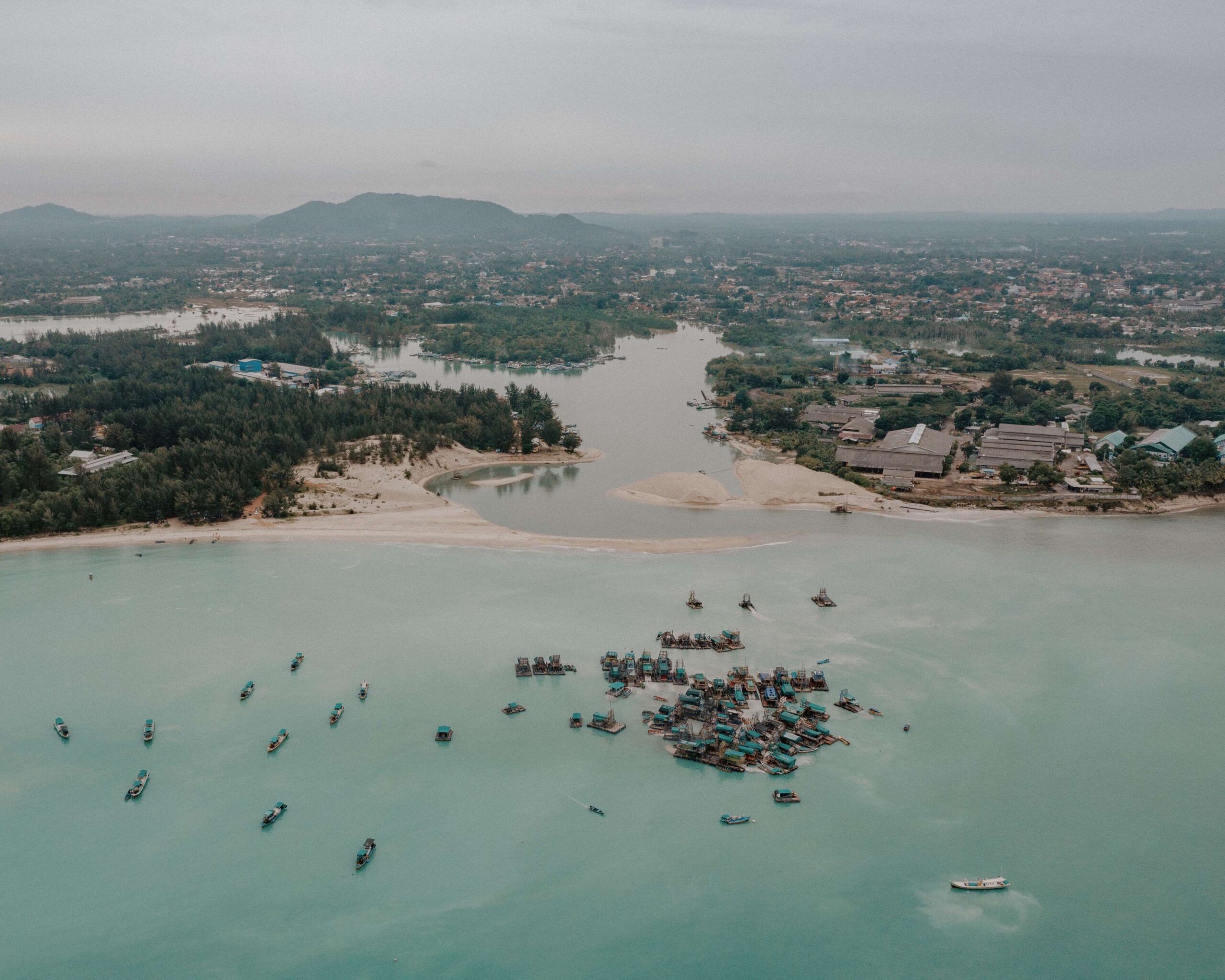
Decades of tin mining have transformed the landscape, leaving behind vast stretches of sand and thousands of dangerous abandoned mining pits where there used to be fertile farmland. As mining increasingly moves offshore – driven by growing global demand – dredging of the seabed is damaging coral reefs, mangroves and seagrass meadows, effecting the livelihoods of coastal communities as well as the global blue carbon stocks.
In the past, when we fished, we would catch 10–15 kg of fish, but now we only get 3–5 kg, says a fisher from the islands who was interviewed for the report.
As catches decline and farmland becomes unusable, people are increasingly pushed towards mining as a source of income. This cycle of environmental destruction and growing dependence on mining is a central finding of the report Critical for Whom? Tin Mining, Human Rights and the Green Transition in Indonesia, published by Swedwatch together with the Swedish Society for Nature Conservation and WALHI, Indonesia’s largest environmental NGO.
Dangerous work, few alternatives
For those who turn to mining, the risks are considerable. Workers face collapsing mine walls, dangerous machinery and inadequate protection. Interviewees describe widespread use of methamphetamine among miners to combat fatigue.
Extensive illegal mining, both on land and offshore, further increases these risks while undermining oversight and traceability, as legally and illegally mined tin has reportedly been mixed at smelters.
As alternative sources of income dwindle, some families also rely on their children to work in the mines, with some children leaving school altogether. Girls face additional risks, including sexual harassment and exploitation around mining sites. Some are also trafficked to the islands with false promises of work.
Despite the profound impacts on their lives, affected communities describe having little say in decisions about mining. Permits are often issued without prior meaningful consultation, leaving residents with limited influence over activities that affect their land and waters.
From Indonesian mines to global supply chains
The tin extracted from Bangka Belitung travels far beyond Indonesia. Through networks of collectors, traders, smelters and refiners, it enters global supply chains, eventually reaching industries producing electronics, vehicles and technologies used in the green transition.
As part of the research, publicly disclosed smelter and refinery lists were used to identify links between the region’s tin industry and the supply chains of Ericsson, Apple, Tesla and Volkswagen Group.
All four companies were contacted about how they address human rights and environmental risks in their tin supply chains. Only Ericsson engaged with Swedwatch during research. The company acknowledged difficulties in tracing tin to individual mines and stated that it would take appropriate action where credible evidence linked suppliers or smelters to serious harm. (See more under “Company engagement & response”.)
Conclusion and key recommendations
The report’s title asks for whom tin is critical. For the global economy, it is critical as
a material. For the communities of Bangka Belitung, it has been critical in a different sense: their land, sea and futures have been reshaped by its extraction. Companies relying on tin for their business have a responsibility to act on these harms.
The report calls on companies to look beyond audits and certification schemes, investigate conditions where minerals are extracted and engage directly with affected communities. It also urges investors and policymakers to use their influence to prevent harm and ensure that abuses are addressed.
Businesses, investors and states have a joint responsibility to protect human rights. This cannot be achieved without investigating what is happening where minerals are extracted and listening to affected communities.
The green transition must happen, but it cannot come at the expense of invaluable ecosystems and those living with the impacts of mining, says Sofia Käll, Project Manager at Swedwatch.
Key recommendations
To companies & investors
✔️Look beyond audits and certifications. Conduct ongoing human rights and environmental due diligence throughout mineral supply chains, including at mine level.
✔️Ensure traceability and transparency. Map supply chains down to individual mines and address risks linked to illegal mining and environmental destruction.
✔️Engage with affected communities and ensure remedy. Listen to workers and communities, including women, and take action to address harm and support ecosystem restoration.
To the EU & Government’s
✔️Strengthen human rights and environmental requirements. Ensure effective due diligence throughout mineral supply chains, including offshore mining, and access to remedy for affected communities.
✔️Strengthen oversight and support civil society. Address gaps in EU minerals regulations and support environmental and human rights defenders in Indonesia.
Download the report
About the research
On-site research was conducted by Swedwatch and WALHI in Bangka Belitung in November 2025, including site visits, focus group discussions with young people and interviews with community members and experts. The research was complemented by a review of secondary sources and outreach to four companies linked to the region’s tin supply chains. Photos were taken by Indonesian photographer Muhammed Fadli.
Company engagement & response
As part of the research, a selection of global companies – Apple, Tesla, Volkswagen Group and Ericsson – were contacted about their due diligence practices regarding tin linked to Bangka Belitung. Only Ericsson engaged during research, see their full response here.
The final version of the report was shared with all companies mentioned and they were offered the opportunity to publish a comment on the findings on Swedwatch’s website. Volkswagen Group reached after the report was shared, stating that their lack of capacity to engage during research should not be understood as a general unwillingness of the Group to engage on responsible sourcing issues.
Tin extraction
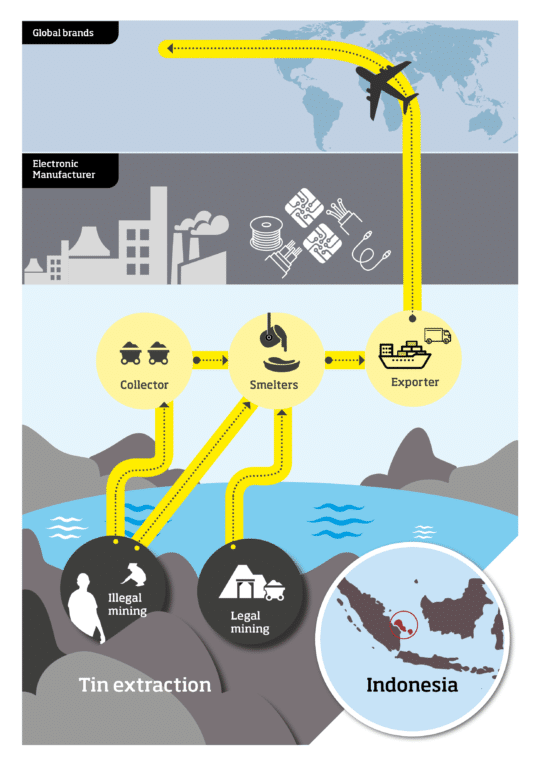
Once processed, the metal is used in solder and electronic components that are incorporated into products such as smartphones, electronic vehicles and solar power electronics. Multinational companies are connected to mining through several tiers of suppliers ⬆️.
The Bangka Belitung Islands
The two islands are the epicenter of Indonesia’s tin mining and a vital contributor to the global tin industry. Indonesia is ranked the second-largest supplier after China and supplies one-fifth of the world’s total production. Bangka Belitung alone contributes with 90–95 percent of the production.
Related research: Nickel mining & investor responsibility
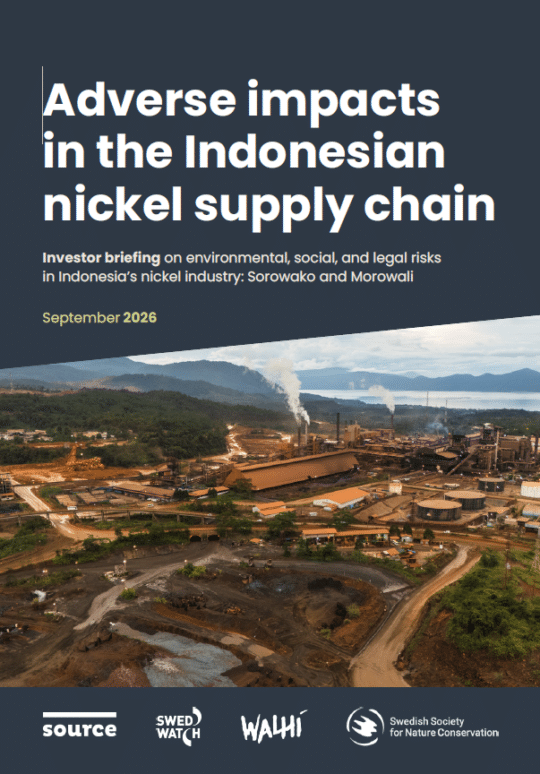
⬆️Nickel is another key mineral for the green transition and electric vehicle (EV) batteries in particular, with Indonesia accounting for roughly 60% of global production. This briefing from September 2026 examines environmental & social concerns linked to nickel mining & refining at two of the largest nickel operations on Sulawesi. Drawing on the experiences of affected communities, workers & environmental evidence, it highlights the risks associated with nickel production & the responsibilities and influence of investors in addressing them.
Behind the tin: Life on Bangka Island ⬇️
Explore everyday life, mining work and the impacts of tin extraction on Bangka Island through photographs of communities, workers and mining sites on land and at sea. The images were captured during the research and by Indonesian photographer Muhammad Fadli.