
Swedwatch appointed to EU expert group on public procurement
Swedwatch has been appointed as a member of the European Commission’s Stakeholder Expert Group on Public Procurement (SEGPP). This appointment comes at a pivotal moment as the Commission embarks on a revision of the EU’s 2014 Public Procurement Directive. Integration of mandatory social and environmental criteria into the Directive has the potential to significantly improve the lives of millions of workers in global procurement supply chains.
As announced by European Commission President Ursula von der Leyen’s 2024–2027 political guidelines, the Commission recently commenced with the review of the current Public Procurement Directive. In support of this initiative, the expert group SEGPP will provide high-level input from key stakeholders. Swedwatch has been appointed as the only NGO among ten members, earning its seat through a rigorous selection process, underscoring its commitment to promoting sustainable procurement practices.
“Our research shows that workers in the public sector’s supply chain continue to be exposed to labour violations and human rights abuse. The revision of the Directive has the potential to deliver significant benefits for such workers — whether they are producing textiles for our hospitals or working in the construction or service industry,” says Sofia Käll, who is leading Swedwatch’s engagement in the group.
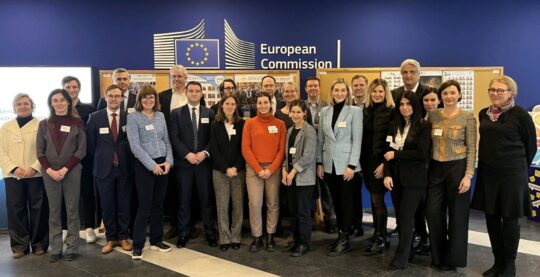
The SEGPP’s met in Brussels early February, to discuss the future of public procurement.
Critical shortcomings in the directive
Under current Public Procurement Directive, only a small share of procurement procedures incorporate criteria beyond lowest price. This stems partly from the directive’s voluntary approach to integrating social or environmental criteria, which makes enforcement challenging.
Another critical shortcoming in the current directive is the limited ability of procuring authorities to assess and exclude companies or bidders that fail to comply with human rights and labour laws. These legal gaps pose challenges to promoting fair and ethical procurement.
In addition to advocating for legislative revisions, Swedwatch will call on the Commission to facilitate capacity-building and provide additional resources for procurement officials across EU Member States.
“Efforts to raise awareness and build knowledge among contracting authorities — such as effective monitoring of supplier compliance and incorporating sustainability criteria — are as crucial as addressing the legislative shortcomings,” says Sofia Käll.
Download Swedwatch’s position paper

The revision of the Directive has the potential to deliver significant benefits for workers — whether they are producing textiles for our hospitals or working in the construction or service industry. /Sofia Käll, Swedwatch
Contact

For questions, please contact our public procurement expert:
Sofia Käll
+46 (0)70 290 97 35
sofia@swedwatch.org