Calling on Swedish decision-makers to stop the Omnibus proposal
The Commission’s Omnibus Proposal was unveiled on February 26, and as feared, it suggests drastic rollbacks to several key sustainability EU laws, including the already adopted Corporate Sustainability Due Diligence Directive (CSDDD). In an open letter, Swedwatch and other organisations urge Sweden to take a stand and ensure that hard-won progress on corporate accountability and sustainability is not undone.
The EU was making progress towards improving global standards for responsible business conduct. Weakening these laws, as suggested in the EU Commission’s Omnibus proposal , would be a devastating step backward. If passed, the Omnibus would allow human rights abuses, environmental destruction, and worker exploitation to persist , while companies maintain a misleading image of compliance.
The laws concerned by the Omnibus include the sustainability reporting directive (CSRD), the Taxonomy and the CSDDD – the new EU law that imposes binding obligations on corporate giants to check their global value chains for human rights and environmental risks and harms. The suggested changes would make the CSDDD more or less toothless.
The proposed changes include limiting due diligence to only tier 1 suppliers, removing the requirement to put into effect the climate transition plans, and effectively limiting civil liability by leaving it to the discretion of member states. Additionally, the proposal enforces maximum harmonisation, preventing member states from going beyond minimum requirements; and finally, the transposition has been postponed by one year, to 2027.
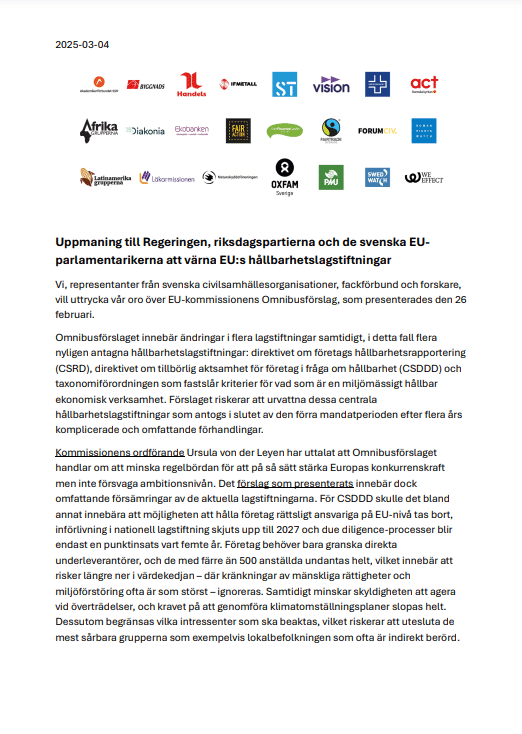
In an open letter, Swedwatch and 39 other signatories – from civil society, trade unions and academia – urge Swedish decision-makers to stand against the Omnibus proposal and safeguard core elements of the CSDDD. If any change has to be made, it should only involve overlapping or unnecessary reporting obligations.
How Omnibus would impact the CSDDD:
✔️ The ability to hold companies legally accountable at the EU level is removed.
✔️ Implementation into national law is delayed by one year, until 2027.
✔️ Risk analysis for negative human rights impacts is reduced to a one-time measure instead of an ongoing due diligence process.
✔️ Companies only need to assess direct suppliers, and those with fewer than 500 employees are entirely exempt.
✔️ The obligation to act on violations is weakened.
✔️ The requirement to implement climate transition plans is completely abolished.
✔️ Fewer stakeholders must be consulted, risking the exclusion of vulnerable groups, such as affected local communities.
Read the letter (in Swedish)
Swedish decision-makers have a crucial role to play in defending the EU’s sustainability agenda. We hope they take responsibility by pressuring the Commission to focus on effective implementation rather than wasting time and resources on renegotiations, which also creates significant uncertainty for businesses. /Olivia Nordell, Swedwatch.
Contact

Olivia Nordell, Program Officer, Swedwatch
+4673 383 71 28
olivia@swedwatch.org