2019-05-07
Swedwatch raises new perspective on company responsibility at OECD
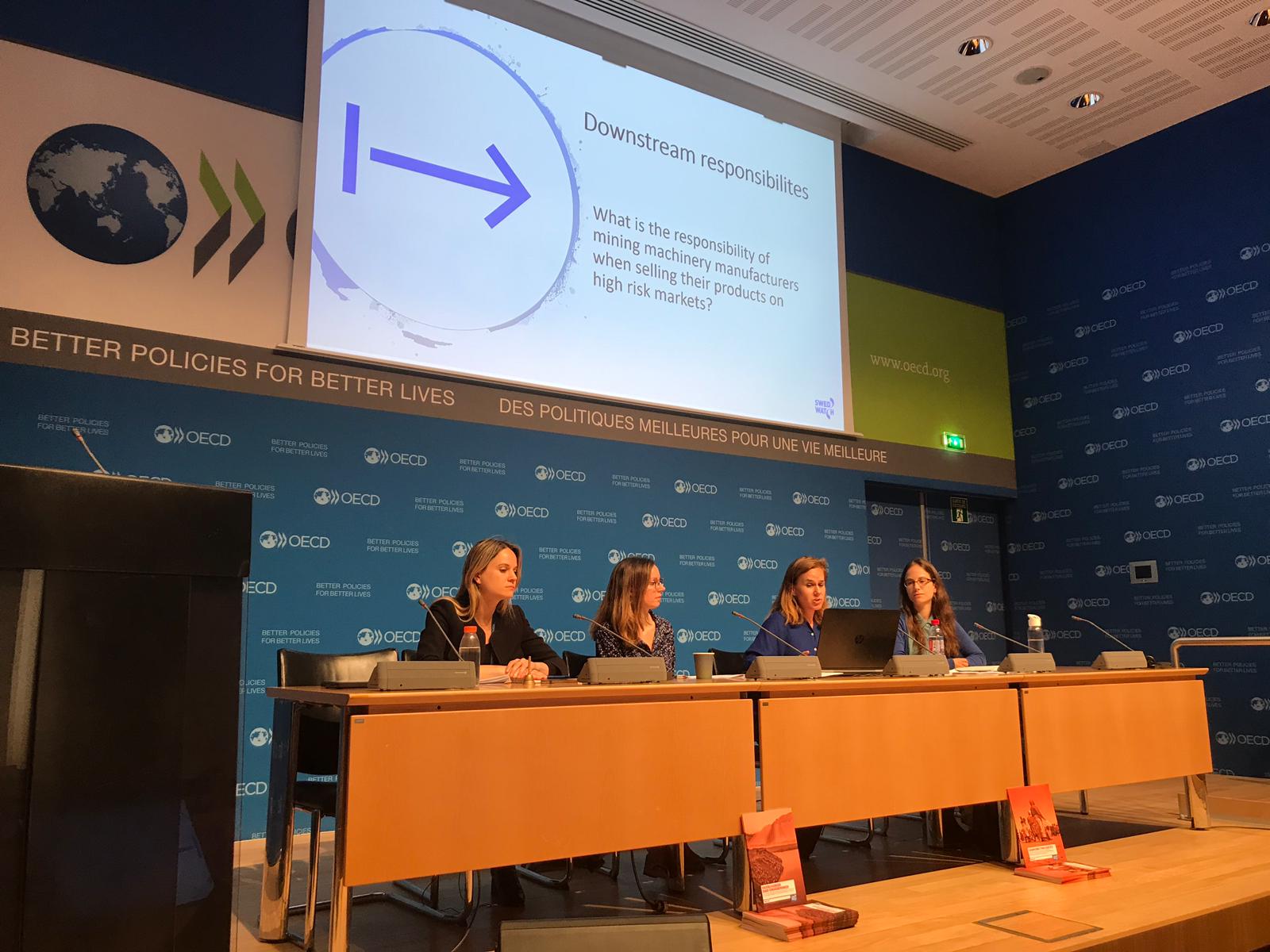
What are the responsibilties of companies who sell mining equipment on high-risk markets? This was discussed at Swedwatch’s panel at the 13th OECD Forum on Responsible Mineral Supply Chains.
During the last week of April 2019, the annual OECD Forum on Responsible Mineral Supply Chains was held in Paris. More than one thousand representatives from governments, companies, UN agencies and civil society gathered to discuss challenges related to specific minerals such as diamonds, base metals, cobalt, and the four conflict minerals tin, tantalum, tungsten and gold (3TG).
The mining sector is associated with extensive risks and impacts on people and the planet. These include child labour, water pollution and financing of armed conflict. At the OECD conference, topics centered around company reporting requirements, corruption challenges and the need to improve flawed sustainability certifications of minerals such as the Kimberley Process Certificate (which applies to diamonds).
A key message by civil society representatives was the need for companies to conduct due diligence processes that are holistic - ones that not only focus on impacts at the mine site but consider the impacts on surrounding local communities. Conflict-affected contexts such as the Democratic Republic of the Congo and Colombia were at the heart of many discussions. In his opening statement, Sweden’s former Prime Minister and current Chair of the Extractive Industries Transparency Initiative, Fredrik Reinfeldt, referred to Myanmar as an urgent case where mining and armed conflict are intrinsically connected.
Swedwatch’s panel
Swedwatch was part of the official programme and hosted a panel on the responsibilities of companies that provide equipment to problematic mining operations in conflict-affected contexts. Under the heading “Selling mining machinery on high-risk markets – the need for downstream due diligence to avoid complicity in human rights violations”, Swedwatch discussed, together with experts from the OECD and the Business and Human Rights Resource Centre, what companies can and should do if their products are found to be used in a way that risk undermining human rights and negatively impacting the environment. Swedwatch presented two of its reports with case studies from Myanmar and South Africa, illustrating how irresponsible use of mining equipment - sold by international mining machinery brands such as Atlas Copco, Caterpillar, Komatsu, Sandvik and Volvo CE - has caused severe negative impacts on local communities and ecosystems.
Eniko Horvath, senior researcher at the Business and Human Rights Resource Centre participated in the panel and noted that to date discussions on fair supply chains in the mining sector have mostly focused on upstream responsibilities*. However, companies have a responsibility to undertake human rights due diligence for their value chains both upstream and downstream**, wherever there are potential human rights issues at risk. Horvath referred to the UN Guiding Principles on Business and Human Rights (UNGPs), which stipulate that human rights due diligence should “cover adverse human rights impacts that the business enterprise may cause or contribute to through its own activities, or which may be directly linked to its operations, products or services by its business relationships.”
“This means that under the UNGPs, mining machinery companies that sell products on high-risk markets have a responsibility to undertake human rights due diligence to ensure that their products are not used to facilitate adverse human rights impacts. Swedwatch has already done much of the work that companies need to do in terms of identifying where some of those high-risk markets are – but there might be others as well so it’s important to undertake a full human rights due diligence process across the company”, Horvath said.
Horvath also stressed that under the UNGPs, it is clear that providers of mining equipment have a responsibility to use their leverage (i.e. influence over a business partner or customer) to prevent or mitigate human rights abuses linked to the use of their products, and concluded that “once the company establishes that its products are used in this harmful way, it should engage with the user to ensure non-repetition of adverse impacts. Ultimately, it must stop selling the products to these customers if impacts are likely to continue. In addition, the company must provide or collaborate in providing access to remedy for victims of adverse impacts.”
Panellist Barbara Bijelic, Legal Expert within the Responsible Business Conduct Unit at the OECD, concluded that although the OECD has developed extensive guidance for human rights due diligence, the guidance has mostly focused on upstream due diligence, and that further consideration of enterprise responsibilities and approaches with respect to downstream due diligence would be valuable.
The panel also discussed the role of home governments. Swedwatch raised the positive example of the Swedish Export Credits Guarantee Board which requires companies to conduct a due diligence for human rights and the environment in order to receive export credit support.
“This requirement has pushed Swedish companies to develop their due diligence processes and skills, and there appears to be a spill-over effect in that some of these companies are now considering to conduct due diligence also for sales that are not dependent on export credit guarantees,” said Therese Sjöström-Jaekel, researcher at Swedwatch and author of the report on jade mining in Myanmar.
The panel concluded with two key recommendations to governments: include clear guidance on downstream due diligence for human rights and the environment in National Action Plans on Business on Human Rights and consider mandatory human rights due diligence legislation.
* “Upstream” activities include operations that relate to the initial stages of producing a good or service, including material sourcing, material processing, and supplier activities.
**"Downstream" activities include operations that relate to processing the materials into a finished product and delivering it to the end user, including transportation, distribution, consumption and disposal/recycling.
Swedwatch would like to extend its gratitude to the panel moderator Tara Norton, Managing Director, Global Supply Chain Sustainability Practices at Business for Social Responsibility.
- Focus Areas: High-risk and conflict areas
- Industry: Machinery and construction
- Publication: Article
