Investor briefing
ADVERSE IMPACTS IN THE NICKEL SUPPLY CHAIN – WHAT THIS MEANS FOR INVESTORS
Demand for nickel is expected to grow as the climate transition accelerates, driven by electric vehicle batteries and other fossil-free technologies, alongside demand from sectors such as defense.
In this briefing we examine environmental and social concerns linked to nickel production at the two largest nickel mining and refining operations on the island Sulawesi, Indonesia. It draws on the experiences of affected communities and workers, alongside environmental evidence, and considers what these findings mean for investors and their responsibilities and leverage within nickel value chains.
Forced labour, land issues and causalities
The stories reported across workers and communities and other affected groups raise serious concerns at both sites investigated. At Sorowako, located on the south of Sulawesi, concerns include unresolved Indigenous land dispossession and inadequate compensation for communities affected by flooding. At Morowali, North-East Sulawesi, reports allege working conditions that may be consistent with indicators of forced labour, alongside several recorded worker deaths (52 between 2016 and 2024).
Pollution by far exceeding legal limits
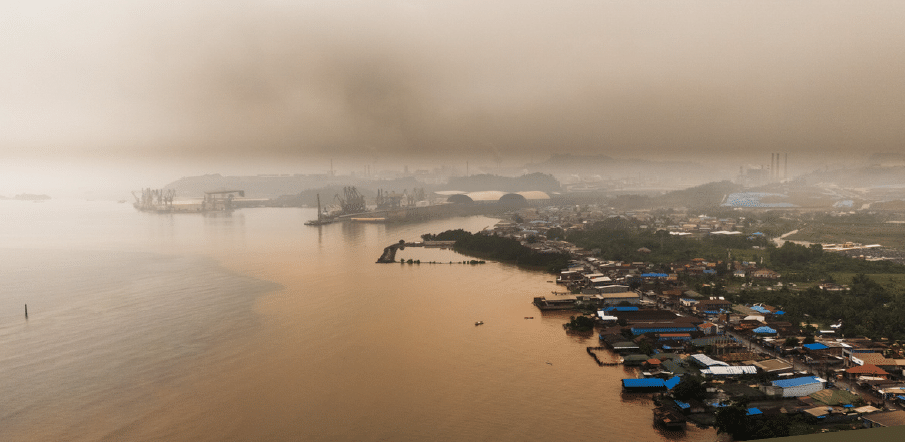
The briefing also provides measurable environmental evidence alongside reported concerns. Monitoring of water, sediment and air found concerning levels of pollution at both sites, in many cases by far exceeding Indonesian legal limits. Key findings include hexavalent chromium, a known carcinogen, were levels where more than ten times the Indonesian legal limit, while manganese levels (known to cause severe neurological damage if high levels) exceeded the legal limit by a factor of 110.
Further details on the reported concerns and environmental evidence are available in the briefing.
Why investors need to pay attention
These negative impacts can give rise to various risks for companies and projects concerned, which may in turn translate into risks for investors. Potential consequences at company or project level include fines and restrictions on access to the EU market, as well as supply disruptions arising from fatal incidents, government sanctions and unresolved land disputes. And with the evolving EU requirements, investors need not least to ensure portfolio companies follow the new Corporate Sustainability Due Diligence Directive (CSDDD).
At the same time, investors have leverage to influence how the sector develops. Through capital allocation and engagement, they can push for stronger environmental and social practices in mining while directing finance towards solutions that reduce reliance on new extraction.
The briefing examines these risks in more detail and sets out forward-looking recommendations for investor action. Key recommendations are summarised below.
What financial investors could do:
1️⃣ Require portfolio companies to identify, prevent and address severe human rights and environmental risks across the full value chain, including risks (social to environmental) associated with Indonesian nickel.
2️⃣Require portfolio companies to establish effective traceability and transparency of nickel supply chains and ensure meaningful engagement with affected local communities and rights holders, including respect for Indigenous peoples’ rights to land.
3️⃣Require portfolio companies to take timely action where serious environmental or human rights impacts are identified, including independent monitoring, pollution prevention, restoration and effective remedy, and ensure that companies provide accessible grievance mechanisms and appropriate remedy.
4️⃣Establish time-bound expectations and measurable indicators for responsible sourcing, human rights, environmental performance and remedy, and regularly assess portfolio companies’ progress. Where companies fail, investors should use available leverage, including active engagement, voting, etc.
5️⃣Align the capital allocation with a transition that reduces dependence on primary extraction through circularity, recycling, resource efficiency, lower-material intensity solutions and development of infrastructure that reduces reliance on critical minerals.
Download the briefing
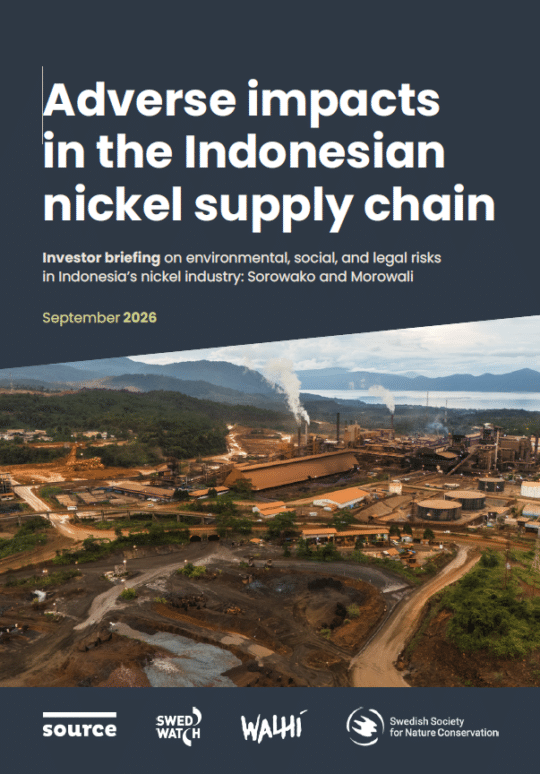
The briefing is developed by Swedwatch together with Source International, WALHI South Sulawesi and the Swedish Society for Nature Conservation.
Nickel mining in Indonesia
Indonesia is the world’s leading producer of nickel, supplying roughly 60% of global output largely driven by demand for electric vehicle (EV) batteries and stainless steel. Since banning raw nickel ore exports in 2020, Indonesia has required domestic processing, drawing billions in investments – primarily from Chinese firms – to build local smelters and High-Pressure Acid Leaching (HPAL) plants.
About the research
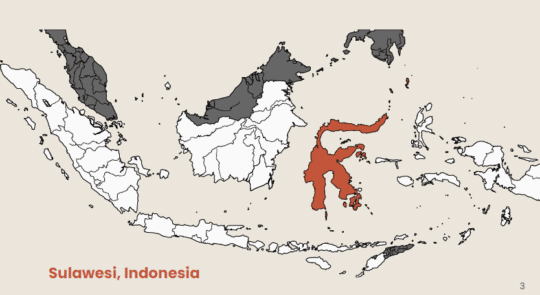
⬆️Field research was conducted in May and November 2025 on Sulawesi Indonesia, and the two largest nickel mining and refining operations on the island: PT Vale Indonesia Tbk in Sorowako and PT Indonesia Morowali Industrial Park (IMIP) in Morowali. Companies sourcing nickel from Sulawesi include the major EV automakers.
It combines qualitative and quantitative data; interviews and focus group discussions with workers, trade union representatives, indigenous peoples and communities affected by nickel mining, and assessments of environmental contamination – quantified heavy metals in water, sediments, and airborne dust along with particulate matter and potentially harmful gases in air.
