Business & Human Rights in the EAP region
Stay on top of the latest developments on business and human rights in the Eastern Partnership region.
Business and human rights is gaining global momentum, including in the Eastern Partnership (Ukraine, Georgia, Moldova, Armenia and Azerbaijan). BHR is still an emerging topic in the region, but its importance is rising due to EU integration ambitions, new EU laws, risks linked to the war in Ukraine, and persistent challenges such as weak rule of law, state-owned enterprise influence, and ongoing labour and environmental concerns.
Subscribe to receive news updates, events, and analysis on business and human rights in the Eastern Partnership region.
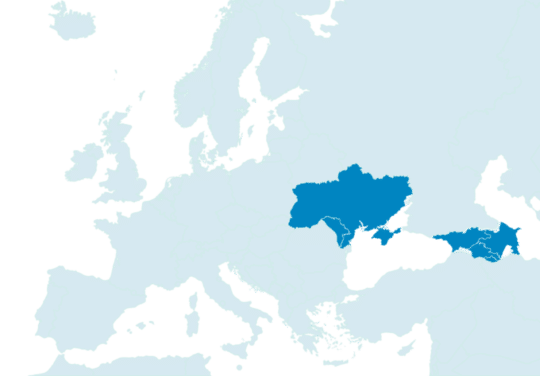
EAP region includes Ukraine, Georgia, Moldova, Armenia and Azerbaijan.
Policy brief
Corporate Sustainability, Accountability and Business and Human Rights in EU Candidate Countries
Moldova, Ukraine and Georgia in the Context of EU Enlargement
Based on the analyses of the Ukraine report 2025, Georgia report 2025 and Moldova report 2025
by the Directorate-General for Enlargement and Eastern Neighbourhood.
Executive Summary
As the EU advances its green and social policy agenda, including mandatory corporate sustainability reporting and human rights due diligence, candidate countries are navigating a rapidly evolving regulatory landscape. Moldova and Ukraine are progressing in aligning institutional frameworks on climate, environment, anti-corruption and labour rights, although implementation capacity remains uneven. Georgia has seen a slowing of previous progress in certain governance-related areas, shaping the broader enabling environment for sustainable business conduct.
Across all three countries, a common gap remains: the EU accession process does not yet clearly articulate how the emerging EU corporate sustainability framework applies to candidate countries. This creates uncertainty for policymakers, regulators and businesses regarding the pace, sequencing and mandatory nature of alignment with instruments such as the Corporate Sustainability Reporting Directive (CSRD), the Corporate Sustainability Due Diligence Directive (CSDDD), the EU Taxonomy or sustainable finance standards.
A more intentional and explicit integration of sustainability-related corporate regulation within accession benchmarks would support rule of law consolidation, ensure predictability for economic actors and reinforce the EU’s normative coherence across internal and external policy.
---
1. Regional Overview
1.1 Corporate Sustainability
Moldova and Ukraine have taken measurable steps toward aligning with EU climate and environmental acquis. Both have national energy and climate plans and are strengthening monitoring and enforcement systems related to emissions, waste, water
and environmental impact assessments. Ukraine additionally plans an emissions trading system compatible with the EU ETS and has begun integrating sustainability considerations into financial regulation linked to reconstruction.
In Georgia, regulatory progress is limited. While frameworks exist on paper, weak enforcement capacity and political volatility have slowed environmental governance reforms.
Implication: Sustainability alignment is occurring, but at different speeds, with enforcement capacity emerging as the key determinant rather than legal harmonisation alone.
1.2 Corporate Accountability and Rule of Law
Ukraine has established a specialised and relatively advanced anti-corruption and accountability architecture that continues to operate despite wartime pressures. Moldova is improving institutional frameworks but remains vulnerable to political fluctuation and capacity gaps.
Georgia has seen a slowing of previous progress in certain governance-related areas. Implication: Accountability frameworks required for responsible business conduct are strengthening in Moldova and Ukraine, while progress in Georgia appears more mixed, shaping the overall risk environment for sustainability reforms.
1.3 Business and Human Rights
Alignment with EU labour standards, occupational safety frameworks and anti- discrimination norms is progressing in Moldova and Ukraine. Ukraine has introduced reforms relevant to post-war recovery and vulnerable groups, reflecting an intention to integrate human rights into economic reconstruction.
Implication: The conditions required to operationalise the UN Guiding Principles are emerging in Moldova and Ukraine but are significantly weakened in Georgia.
1.4 SDG Alignment
Progress across the Sustainable Development Goals varies, with the strongest alignment observed in SDG 8 (decent work), SDG 13 (climate action) and SDG 16 (rule of law and strong institutions) in Moldova and Ukraine.
In Georgia, developments in governance and rights-related areas may influence the broader enabling environment for achieving other SDGs linked to sustainability, business accountability, and social inclusion.
2. Conclusion
The accession process is influencing corporate sustainability and accountability reforms, but unevenly. Moldova and Ukraine are moving toward EU standards, though
enforcement capacity remains the primary constraint. Georgia’s evolving context may affect the environment for advancing responsible business conduct and sustainability integration.
A key cross cutting observation is that the EU’s expectations regarding the emerging corporate sustainability framework are not yet clearly communicated within the enlargement process. With the EU transitioning to mandatory due diligence and sustainability disclosure regimes internally, leaving these frameworks optional or implicit externally produces uncertainty and fragmented alignment.
Clarifying how instruments such as CSRD, CSDDD and sustainable finance regulation fit within accession conditionality would strengthen regulatory predictability, reinforce rule of law objectives and ensure coherence between EU internal policy and enlargement strategy.
3. Policy Recommendations
3.1 For the European Union
- Integrate CSRD, CSDDD and EU sustainable finance alignment requirements explicitly into accession benchmarks.
- Link future financial assistance and technical support to measurable enforcement outcomes rather than legislative adoption alone.
- Ensure enlargement methodology reflects the role of accountable institutions, labour rights and civic space in enabling responsible business conduct.
3.2 For Candidate Governments
- Strengthen enforcement capacity through independent regulators, labour inspectorates and judicial safeguards.
- Prepare businesses and SOEs for EU sustainability and due diligence obligations through guidance, capacity building and phased regulatory alignment.
- Establish or reinforce grievance mechanisms to ensure remedy for business–related harm.
3.3 For International Partners
- Support institutional strengthening rather than fragmented project-based approaches.
- Embed sustainability conditions across investment, procurement and reconstruction funding.
- Foster cross-border cooperation on ESG compliance, particularly in value chains relevant to energy, agriculture and reconstruction.
Organized by